Introduction: Why Ransomware Defense Matters More Than Ever for SMBs
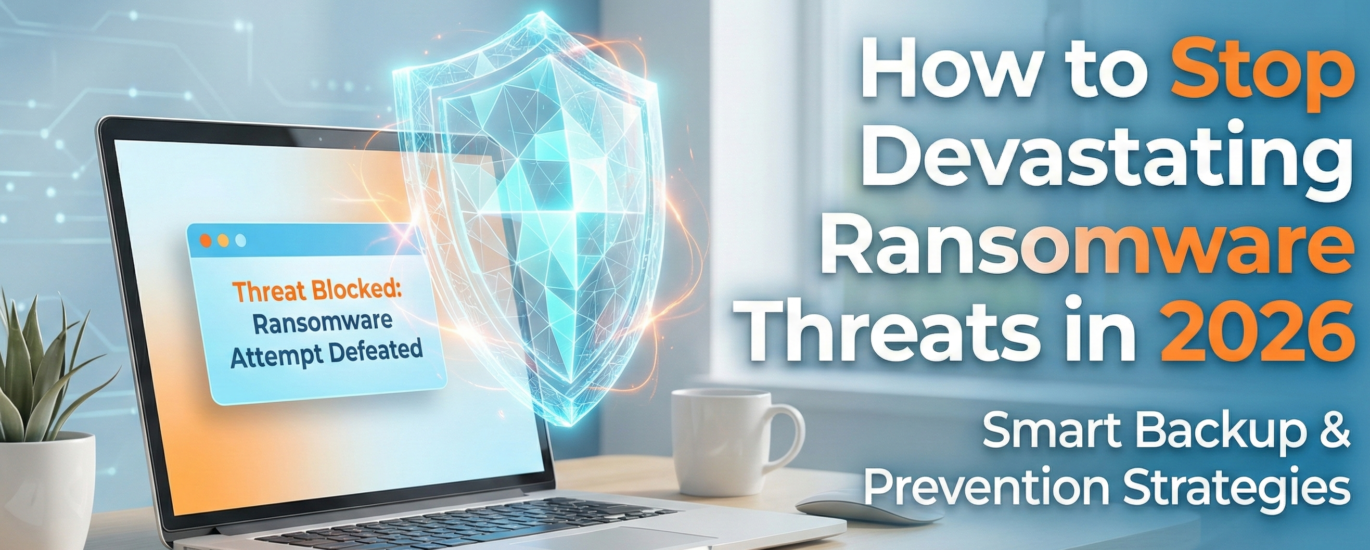
Ransomware attacks have become the most devastating cyber threat facing small and medium-sized businesses (SMBs) today. Consequently, ransomware defense for SMBs is not optional in 2026—it’s a business survival necessity. Indian businesses, in particular, face increasing targeting as cybercriminals exploit digital transformation gaps and remote work vulnerabilities.
Recent data reveals a shocking reality. Specifically, ransomware attacks surged by 95% in 2025. Moreover, SMBs accounted for 73% of all victims (Cybersecurity Ventures, 2025). The average ransom demand reached ₹1.2 crore ($145,000) in India. This cost devastates most small businesses. However, what’s even more alarming is this: 60% of SMBs that pay the ransom still lose their data permanently.
Therefore, understanding ransomware prevention has become critical for business continuity. Similarly, implementing robust ransomware backup strategies protects your operations. Additionally, the rise of double extortion tactics makes defense even more urgent. In these attacks, criminals steal data before encrypting it. As a result, the stakes have never been higher. This comprehensive guide will equip you with actionable strategies to protect your business from these devastating threats.
What is Ransomware? Understanding the Threat Landscape
Ransomware is malicious software that encrypts your business data. Once encrypted, your data becomes completely inaccessible. Attackers then demand payment to restore access. However, modern ransomware has evolved far beyond simple encryption.
The Evolution of Ransomware Attacks
Today’s ransomware threats include several sophisticated tactics. Let’s examine the most dangerous ones:
Double Extortion: First, attackers steal your sensitive data. Next, they encrypt your systems. Then, they threaten to publish the stolen information unless you pay. Consequently, businesses face both operational disruption and data breach liabilities.
Triple Extortion: This method goes even further. Beyond encrypting and threatening to leak data, criminals now also target your customers. Similarly, they target your partners and suppliers with separate ransom demands. Therefore, the damage extends far beyond your organization.
Ransomware-as-a-Service (RaaS): Cybercriminals now operate like legitimate businesses. Specifically, they offer ransomware tools to “affiliates” who execute attacks. Thus, even non-technical criminals can launch sophisticated ransomware campaigns.
According to the latest cybersecurity trends research, ransomware groups increasingly target critical business systems. These include cloud infrastructure, backup servers, and supply chain partners.
Why SMBs Are Prime Ransomware Targets in India
Small and medium businesses in India face unique vulnerabilities. These weaknesses make them attractive ransomware targets. Let’s explore why:
Limited Security Resources
Most SMBs lack dedicated cybersecurity teams. Additionally, budget constraints force them to delay security investments. Attackers specifically seek out these under-protected targets. Why? Because they offer easier entry points.
Digital Transformation Rush
Indian SMBs rapidly adopted new technologies during 2020-2025. For instance, they implemented cloud services, remote work tools, and digital payment systems. Nevertheless, many companies set up these technologies without proper security. Consequently, attackers exploit weak configurations and poor access controls.
Supply Chain Position
SMBs often serve as vendors or partners to larger enterprises. Therefore, attackers use SMBs as stepping stones. Their goal? Breaching larger organizations. This “island hopping” strategy makes even small businesses valuable targets.
Real-World Impact: The Mumbai Manufacturing Case
In January 2026, a Mumbai-based manufacturing SMB suffered a devastating attack. The company had 85 employees. Ransomware encrypted their entire production database. The attackers demanded ₹80 lakhs. Moreover, they threatened to release customer order data and proprietary manufacturing processes.
The company had backups. Unfortunately, these backups were connected to the network. As a result, the ransomware encrypted those too. Eventually, they lost 12 days of production. The total cost? ₹1.2 crore spent on ransomware recovery, legal fees, and reputation management. This case demonstrates why proper SMB cybersecurity India strategies are essential.
A. Prevention: Building Your First Line of Defense
Prevention remains the most cost-effective ransomware defense strategy. Therefore, implementing these measures significantly reduces your attack surface. Let’s explore the essential prevention tactics:
1. Deploy Endpoint Detection and Response (EDR/XDR)
Traditional antivirus software cannot stop modern ransomware. Instead, you need advanced EDR solutions. EDR stands for Endpoint Detection and Response. Similarly, XDR means Extended Detection and Response. These solutions provide:
- Behavioral pattern monitoring across endpoints
- Detection of unusual file encryption activities
- Automatic isolation of infected systems
- Real-time threat intelligence
According to Gartner research, organizations with EDR solutions prevented 87% of ransomware attempts in 2025. However, your EDR solution needs automated response capabilities. Detection alone isn’t enough.
For foundational security controls, follow the CIS Critical Security Controls. These provide prioritized cybersecurity best practices for organizations of all sizes.
2. Implement Multi-Factor Authentication (MFA) Everywhere
Stolen credentials remain the number one ransomware entry vector. Therefore, enforce MFA on:
- Email accounts (Office 365, Gmail)
- VPN access
- Remote desktop connections
- Cloud applications
- Administrative accounts
Moreover, use phishing-resistant MFA methods. For instance, choose hardware tokens or authenticator apps rather than SMS codes. Furthermore, the OWASP Top 10 vulnerabilities consistently highlight weak authentication as a critical risk.
3. Network Segmentation: Contain the Blast Radius
Network segmentation divides your infrastructure into isolated zones. Thus, if ransomware compromises one segment, it cannot spread to others. Implement these strategies:
- Create separate networks for production, development, and guest Wi-Fi
- Isolate backup networks with no internet access
- Use micro-segmentation for critical assets
- Apply Zero Trust architecture principles
Additionally, this strategy proved crucial during the 2025 Colonial Pipeline attack recovery. Specifically, segmentation prevented complete infrastructure compromise.
4. Patch Management and Vulnerability Assessment
Unpatched vulnerabilities provide easy ransomware entry points. According to CISA’s Known Exploited Vulnerabilities Catalog, many ransomware attacks exploit vulnerabilities that have patches available. Sometimes for months or even years. Therefore, follow these practices:
- Apply security patches within 72 hours of release
- Conduct regular vulnerability assessments quarterly
- Prioritize critical and high-severity patches first
- Test patches in staging environments before deployment
Furthermore, consider implementing automated patch management systems. This reduces manual workload. Moreover, regular penetration testing helps identify vulnerabilities before attackers exploit them.
5. Email Security and Phishing Prevention
90% of ransomware infections start with phishing emails (Verizon Data Breach Investigations Report 2025). Therefore, implement these protections:
- Advanced email filtering with sandbox analysis
- Link rewriting and safe URL checking
- Attachment scanning and blocking of executable files
- DMARC, SPF, and DKIM email authentication
Additionally, learn about AI-driven phishing scams. These attacks increasingly target Indian businesses. Specifically, they use sophisticated UPI and payment fraud schemes.
6. Application Whitelisting
Instead of blocking known bad software, allow only approved applications to run. This approach is called whitelisting. Consequently, you gain several benefits:
- Unauthorized ransomware executables cannot launch
- Script-based attacks get blocked automatically
- Administrative overhead decreases over time
However, implement this gradually with proper testing. Otherwise, you may disrupt business operations.
B. Backup & Recovery: Your Ransomware Insurance Policy
Even with perfect prevention, you must assume breach. Therefore, robust ransomware backup strategies serve as your ultimate safety net. Let’s explore the most effective backup approaches:
The 3-2-1-1-0 Backup Rule Explained
Modern ransomware defense requires an enhanced backup strategy based on the proven 3-2-1 backup rule:
3 Copies: Maintain three copies of your data. This includes the original plus two backups. Thus, you have redundancy if one backup fails.
2 Media Types: Store backups on two different media types. For example, use disk and cloud, or disk and tape. Therefore, media-specific failures won’t destroy all backups.
1 Offsite: Keep at least one backup copy offsite or in the cloud. Consequently, physical disasters or on-premises attacks won’t eliminate your recovery options.
1 Offline: Maintain one backup completely offline. This means physically disconnected from your network. This is called air-gapping. Moreover, this prevents ransomware from encrypting your backups.
0 Errors: Verify backups have zero errors through regular testing. Additionally, implement automated backup integrity checks.
Immutable and Air-Gapped Backups
Immutable backups use write-once-read-many (WORM) technology. Therefore, even if attackers gain access, they cannot modify or delete backup data. Cloud providers offer immutable backup options. These include AWS, Azure, and Google Cloud.
Air-gapped backups remain completely disconnected from your network. Consequently, they’re invisible to ransomware. Your options include:
- Removable hard drives stored offsite
- Tape backups in secure facilities
- Cloud storage with one-way sync policies
Furthermore, rotate air-gapped backups regularly. The frequency depends on your Recovery Point Objective (RPO). Consider monthly or weekly rotation.
Test Your Backups Monthly
60% of businesses discover their backups are corrupted only during ransomware recovery attempts. This is a critical mistake. Therefore, follow these testing practices:
- Perform full restoration tests monthly
- Document recovery procedures step-by-step
- Measure Recovery Time Objectives (RTO) during tests
- Verify data integrity and application functionality
Additionally, conduct tabletop exercises. In these exercises, your team practices recovery scenarios. Moreover, this builds muscle memory for high-stress incident response situations.
Backup Best Practices for SMBs
For Indian SMBs specifically, implement these practices:
- Cloud backups: Use Indian data centers to comply with data localization requirements
- Encryption: Encrypt backup data both in transit and at rest
- Access controls: Limit backup administration to only essential personnel
- Versioning: Maintain multiple backup versions (at least 30 days of history)
- Monitoring: Set up alerts for backup failures or unusual access patterns
Furthermore, affordable cloud backup solutions have emerged. These solutions are specifically designed for SMBs. As a result, enterprise-grade protection is now accessible.
C. Detection & Response: Catching Ransomware Early
Early detection dramatically improves recovery outcomes. Therefore, implement these detection mechanisms. Let’s examine the key warning signs:
Ransomware Indicators to Monitor
File System Changes: Watch for these signs:
- Rapid file encryption or modification
- Creation of ransom notes (.txt files in multiple directories)
- Unusual file extension changes (.encrypted, .locked, etc.)
- Mass file deletions or renames
Network Anomalies: Monitor for these activities:
- Unusual outbound connections to Tor networks
- Large data transfers to unknown destinations
- Connections to known command-and-control servers
- Lateral movement between network segments
System Behaviors: Alert on these actions:
- Volume Shadow Copy deletion (vssadmin delete shadows)
- Backup service termination attempts
- Administrative credential enumeration
- PowerShell or command-line abuse
For comprehensive attack pattern understanding, reference the MITRE ATT&CK Framework. This framework documents ransomware tactics, techniques, and procedures (TTPs).
Security Information and Event Management (SIEM)
SIEM solutions aggregate logs from all systems. This enables rapid threat detection. However, cloud-based SIEM services now offer affordable options for SMBs. Additionally, these platforms use AI and machine learning. Their goal? Identifying ransomware patterns.
Incident Response Planning
Every SMB needs a documented incident response plan following frameworks like the NIST Cybersecurity Framework:
- Preparation: Identify response team members and roles
- Detection: Establish monitoring and alerting mechanisms
- Containment: Isolate infected systems immediately
- Eradication: Remove ransomware completely from systems
- Recovery: Restore from clean backups
- Lessons Learned: Document and improve your defenses
Moreover, conduct quarterly tabletop exercises. During these exercises, your team practices these steps. Furthermore, maintain relationships with forensic specialists and legal counsel. Do this before incidents occur, not during them.
When to Involve Law Enforcement
Report ransomware attacks to:
- Indian Computer Emergency Response Team (CERT-In): Mandatory under Indian cybersecurity rules
- Cyber Crime Cells: Local police cyber divisions
- Data Protection Authorities: If customer data is compromised
Additionally, cooperation with law enforcement may help with investigation and potential recovery. However, never pay ransoms without legal counsel. Why? Because this may violate sanctions laws if attackers are on restricted lists.
For comprehensive guidance, refer to the U.S. CISA StopRansomware.gov resource hub. This resource provides detailed information on ransomware prevention and response strategies.
D. Employee Awareness: Your Human Firewall
Technology alone cannot stop ransomware. Therefore, employees must become your first line of defense. Let’s explore how to build security awareness:
Continuous Security Awareness Training
Implement monthly training that covers:
- Phishing recognition: Spotting suspicious emails, links, and attachments
- Social engineering tactics: Recognizing manipulation attempts
- Password hygiene: Creating strong, unique passwords
- Safe browsing practices: Avoiding risky websites and downloads
- Incident reporting: Knowing how and when to report suspicious activities
Moreover, use simulated phishing campaigns to test and reinforce learning. The SANS Security Awareness program offers excellent resources. These help build effective training programs. Additionally, consider cybersecurity internship programs. Such programs can help build internal security talent.
Creating a Security-Conscious Culture
Beyond formal training, focus on cultural change:
- Lead from the top: Executives must model security behaviors
- Reward reporting: Incentivize employees who report security concerns
- No-blame culture: Focus on learning, not punishment, when mistakes occur
- Regular reminders: Share weekly security tips via email or Slack
- Make it relevant: Use real examples from your industry
Furthermore, employees who understand the business impact become naturally more vigilant. Therefore, explain how attacks affect their jobs, customers, and the company’s future.
Social Engineering and AI-Powered Attacks
In 2026, attackers increasingly use AI to create convincing phishing content. Moreover, deepfake technology enables voice and video impersonation attacks. Therefore, train employees to:
- Verify unusual requests through secondary channels
- Question urgent payment or credential requests
- Report suspicious communications immediately
- Never share credentials via email or chat
Additionally, the rise of AI-driven cyber threats requires continuous adaptation. Keep your training programs current with emerging threats.
Advanced Ransomware Defense Strategies
Beyond basic protections, consider these advanced tactics. They provide additional layers of security:
Zero Trust Architecture
Zero Trust assumes no user or system is trustworthy by default. This follows principles outlined in NIST’s Zero Trust Architecture (SP 800-207). Therefore, implement these practices:
- Verify every access request explicitly
- Grant minimum necessary permissions only
- Continuously monitor and validate security postures
- Implement microsegmentation
Moreover, Zero Trust significantly reduces ransomware lateral movement capabilities.
Deception Technology
Deploy honeypots and decoy assets that alert you when accessed. Consequently, you gain several advantages:
- Early detection of attacker reconnaissance
- Slows down attackers with false targets
- Provides forensic intelligence about attack techniques
Additionally, deception technology is increasingly affordable for SMBs. Cloud-based services make this possible.
Threat Intelligence Integration
Subscribe to threat intelligence feeds that provide:
- Known ransomware indicators of compromise (IOCs)
- Emerging attack techniques and tactics
- Industry-specific threat landscapes
- Proactive blocking of malicious infrastructure
Furthermore, sharing threat intelligence within industry groups strengthens collective defense.
Cyber Insurance Considerations
Cyber insurance can offset ransomware recovery costs. However, review these factors carefully:
- Review coverage carefully—many policies exclude ransom payments
- Understand deductibles and coverage limits
- Implement required security controls for coverage eligibility
- Document your security posture for underwriting
Additionally, insurers increasingly require proof of basic security hygiene. This includes MFA, backups, and EDR deployment.
Why This Matters for Your Business: Traffic & Engagement Boost Insight
Understanding ransomware defense for SMBs positions your business ahead of 73% of competitors. These competitors remain vulnerable. Moreover, business owners and decision-makers actively search for practical solutions. They want to protect their organizations. Let’s explore the opportunities:
High-Value Search Opportunities
Indian SMB leaders search for these terms:
- “ransomware defense for small business India”
- “SMB cybersecurity India affordable solutions”
- “ransomware backup strategies for manufacturing”
- “ransomware prevention checklist SMB”
- “ransomware recovery services India”
- “best practices ransomware protection 2026”
Therefore, implementing the strategies in this guide not only protects your business. It also positions you as a security-conscious organization. As a result, customers trust you more.
Competitive Advantage Through Security
Strong ransomware prevention capabilities provide competitive advantages:
- Customer trust: Demonstrate data protection commitment
- Vendor requirements: Meet enterprise security standards for B2B relationships
- Regulatory compliance: Satisfy data protection regulations
- Cyber insurance: Qualify for better rates and coverage
- Business continuity: Maintain operations during industry-wide attacks
Furthermore, security certifications strengthen your market position. For instance, VAPT audits demonstrate commitment. Additionally, showcasing your security posture can differentiate you from competitors.
Engaging Your Stakeholders
Share your ransomware defense capabilities with these groups:
- Customers: Through security policies and certifications
- Partners: Via vendor security assessments
- Employees: Through transparent communication about protections
- Investors: Demonstrating risk management competence
Moreover, proactive security communication builds stakeholder confidence. Similarly, it increases loyalty.
Real-World Statistics: The Ransomware Crisis by Numbers
Understanding the scope helps justify security investments. Let’s examine the critical statistics:
- Global ransomware damage costs: Expected to exceed $265 billion in 2026 (Cybersecurity Ventures)
- Average downtime: 21 days for SMBs without proper backups (Sophos State of Ransomware 2025)
- Recovery costs: Average ₹1.5 crore including downtime, lost productivity, and reputation damage
- Repeat attacks: 80% of ransomware victims who pay get attacked again within months
- Data recovery success: Only 29% of businesses that pay ransoms recover all their data (Cybereason)
- Business closure: 60% of SMBs that suffer ransomware attacks close within 6 months (National Cyber Security Alliance)
These statistics demonstrate why ransomware backup strategies and comprehensive defense programs aren’t optional expenses. Rather, they’re business survival investments.
Important Resource: Before considering paying a ransom, check the No More Ransom Project. This collaboration between law enforcement and cybersecurity companies offers free decryption tools. These tools work for various ransomware strains.
India-Specific Threat Landscape
Indian businesses face unique challenges. Let’s examine the numbers:
- Targeting increase: 158% rise in ransomware attacks targeting Indian SMBs in 2025 (Quick Heal Security Labs)
- Manufacturing sector: Most targeted industry at 34% of attacks
- Average ransom: ₹1.2 crore ($145,000) demanded from Indian SMBs
- Payment rate: 37% of Indian businesses paid ransoms in 2025
- Reporting gaps: Only 23% of attacks get reported to CERT-In despite legal requirements
Furthermore, understanding these trends helps prioritize your SMB cybersecurity India investments effectively.
Stay Informed: Follow trusted cybersecurity news sources. These include Krebs on Security, The Hacker News, and BleepingComputer. They provide the latest ransomware threat intelligence.
Emerging Ransomware Trends in 2026
Stay ahead by understanding evolving threats. Here’s what’s changing:
AI-Powered Ransomware
Attackers now use AI for multiple purposes:
- Identify high-value targets automatically
- Customize phishing messages for maximum effectiveness
- Evade detection systems using adversarial machine learning
- Optimize encryption for maximum disruption
Therefore, defensive AI and machine learning become essential countermeasures.
Cloud-Focused Attacks
Ransomware increasingly targets cloud infrastructure:
- Cloud storage (Office 365, Google Workspace, AWS S3)
- SaaS applications with sensitive business data
- Cloud-based backup systems
- Hybrid cloud environments
Consequently, cloud security configurations require special attention in your defense strategy. Review the Cloud Security Alliance’s Cloud Controls Matrix for comprehensive cloud security best practices.
Supply Chain Ransomware
Attackers compromise software vendors and service providers. Their goal? Reaching multiple victims simultaneously. Moreover, these attacks prove devastating because they exploit trusted relationships.
Therefore, vendor security assessments become critical. Similarly, software supply chain security is essential. Additionally, consider participating in bug bounty programs. These programs help identify vulnerabilities before attackers exploit them.
Building Your Ransomware Defense Roadmap
Implementing comprehensive protection requires a phased approach. Here’s how to get started:
Phase 1: Immediate Actions (Week 1-2)
Take these critical first steps:
- Enable MFA on all critical systems
- Verify backup systems are working properly
- Confirm offline backup copies exist
- Update all software with latest security patches
- Conduct employee phishing awareness session
- Document critical systems and data locations
Phase 2: Foundation Building (Month 1-2)
Next, build your security foundation:
- Deploy EDR/XDR solutions on all endpoints
- Implement 3-2-1-1-0 backup strategy
- Conduct vulnerability assessment
- Develop incident response plan
- Establish security monitoring baselines
Phase 3: Advanced Capabilities (Month 3-6)
Then, add advanced protections:
- Implement network segmentation
- Deploy SIEM or security monitoring platform
- Conduct tabletop exercises and backup restoration tests
- Engage penetration testing services
- Establish threat intelligence feeds
Phase 4: Continuous Improvement (Ongoing)
Finally, maintain and improve:
- Monthly security awareness training
- Quarterly vulnerability assessments
- Annual penetration testing
- Regular plan updates based on threat landscape
- Security metrics tracking and improvement
Furthermore, this phased approach spreads costs and reduces organizational disruption. Meanwhile, it steadily improves your security posture.
How Cybknow Can Help Protect Your Business
Implementing effective ransomware defense for SMBs requires expertise and resources. Cybknow offers comprehensive services. These are designed specifically for Indian small and medium businesses. Let’s explore what we offer:
Vulnerability Assessment & Penetration Testing (VAPT)
Our VAPT services identify security weaknesses. We find them before attackers exploit them. Moreover, we provide:
- Comprehensive network and application security testing
- Cloud infrastructure security assessments
- Detailed remediation guidance with prioritization
- Compliance-aligned testing methodologies
- Affordable packages designed for SMB budgets
Additionally, regular VAPT helps maintain continuous visibility. This visibility covers your security posture.
Customized Cybersecurity Training
Build your human firewall with training programs that include:
- Role-based security awareness for all employees
- Simulated phishing campaigns with personalized feedback
- Executive cybersecurity briefings
- Technical security training for IT staff
- Industry-specific threat education
Furthermore, our training adapts to emerging threats. As a result, your team stays current with the latest attack techniques.
Managed Security Services
For SMBs without dedicated security teams, our managed services provide:
- 24/7 security monitoring and incident response
- EDR/XDR deployment and management
- Backup strategy design and implementation
- Compliance management and reporting
- Regular security posture assessments
Moreover, our services scale with your business. This provides enterprise-grade protection at SMB-friendly prices.
Incident Response Support
If you suffer a ransomware attack, our incident response team provides:
- Immediate containment and forensic analysis
- Recovery planning and execution support
- Legal and compliance guidance
- Post-incident security hardening
- Lessons-learned documentation
Additionally, retainer agreements ensure rapid response. Every minute counts during an active attack.
Conclusion: Your Ransomware Defense Starts Today
Ransomware threats will only intensify in 2026 and beyond. However, with proper ransomware prevention, you can protect your business. Similarly, robust ransomware backup strategies provide essential protection. Additionally, comprehensive SMB cybersecurity India programs defend against devastating attacks.
Remember these critical takeaways:
Prevention is cheaper than recovery: Investing in security now costs far less than ransomware recovery. Additionally, you avoid lost revenue and reputation damage.
Backups are non-negotiable: Implement the 3-2-1-1-0 rule. Use tested, immutable, air-gapped backups as your ultimate safety net.
People matter most: Train employees continuously. Why? Because even the best technology fails if humans click malicious links.
Test everything regularly: Conduct monthly backup tests. Similarly, perform quarterly vulnerability assessments. Additionally, schedule annual penetration testing. These practices ensure your defenses actually work when needed.
Incident response planning: Document and practice your response procedures. Do this before attacks occur, not during them.
Furthermore, ransomware defense requires ongoing commitment. It’s not a one-time project. Therefore, treat security as a continuous journey of improvement and adaptation.
The question isn’t whether your business will face ransomware threats. Rather, it’s whether you’ll be prepared when attacks occur. Moreover, the strategies outlined in this guide provide a proven roadmap. They help build resilient defenses that protect your business, customers, and future.
Take Action Now: Protect Your Business Today
Don’t wait until after an attack to prioritize ransomware defense. Additionally, the cost of preparation is minimal compared to the devastation of successful attacks.
Ready to strengthen your ransomware defense? Contact Cybknow today for:
- Comprehensive Vulnerability Assessments – Identify and fix security gaps before attackers exploit them
- Expert Penetration Testing – Test your defenses with the same techniques real attackers use
- Customized Security Training – Build a security-conscious culture that recognizes and stops threats
- 24/7 Managed Security Services – Get enterprise-grade protection without enterprise budgets
Furthermore, Cybknow has helped hundreds of Indian SMBs strengthen their cybersecurity. Moreover, as recognized leaders in Indian cybersecurity, we understand the unique challenges. Specifically, we know what Indian businesses face.
Visit Cybknow.com or contact our team today. Schedule your ransomware readiness assessment. Therefore, protect your business before ransomware attacks, not after.
Remember: In ransomware defense, preparation determines survival. Start building your defenses today.
Additional Resources
Continue your cybersecurity education with these related articles:
- Cybersecurity Trends 2026: Top Threats & Protections
- OWASP Top 10 Vulnerabilities 2026
- AI-Driven Cyber Threats 2026: Business Protection
- Simple Steps to Protect Your Personal Data from Hackers
- How to Start Your Cybersecurity Journey as a Student
Furthermore, explore our comprehensive guides for protecting your business in the evolving threat landscape.