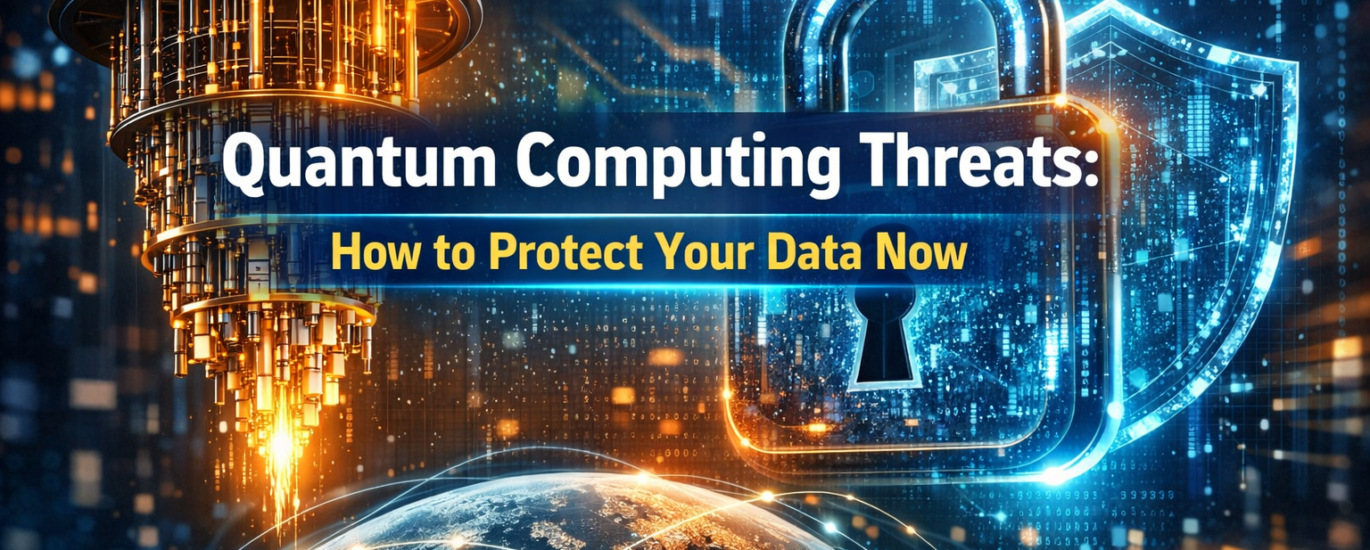
Think about this. Every time you log in to your bank, you rely on math that normal computers cannot crack. A quantum machine, however, could solve those same problems in hours. This is not guesswork. Bad actors are already collecting encrypted data today. They store it now and plan to read it once quantum power grows. Experts call this a “harvest now, decrypt later” attack and the clock is running.
So who is at risk? Governments, banks, hospitals, defense firms, tech companies, and even small businesses with private data all face exposure. Grasping quantum computing threats and acting now is no longer optional. It is a business must.
What Are Quantum Computing Threats in Cybersecurity?
First, let’s understand what makes quantum computers so different. Normal computers store data as bits each bit is either 0 or 1. Quantum computers, however, use qubits. A qubit can be 0 and 1 at the same time. This is called superposition. Also, quantum links let qubits work together in powerful ways. As a result, quantum machines can test millions of answers to a problem all at once.
For security, this matters greatly. Most public-key encryption including RSA, ECC, and Diffie-Hellman relies on math that is too hard for normal computers. A quantum computer, however, solves those problems with ease. As a result, the encryption backbone of the internet faces a core threat.
Shor’s Algorithm: The RSA and ECC Killer
Peter Shor built this method in 1994. A quantum computer using it can split large numbers into factors far faster than normal tools. In practice, RSA-2048 today’s standard could break in hours. ECC faces the same risk, since the same math applies to elliptic curve keys. So TLS/SSL certs, mobile apps, and blockchain are all at risk.
Grover’s Algorithm: Weakening Symmetric Encryption
Grover’s Algorithm targets symmetric encryption like AES. It speeds up searches, which cuts key strength in half. For example, AES-128 drops to about 64-bit security against a quantum attacker. That falls within breaking range. AES-256 drops to 128-bit security still usable, but only just. So upgrading to AES-256 now is a smart first step.
⚠️ Key Takeaway: RSA and ECC the base of internet security are fully at risk from Shor’s Algorithm. Moreover, AES-128 loses half its key power to Grover’s Algorithm. The tools the world trusts today will not last in the quantum age.
Why Quantum Computing Threats Are Dangerous Right Now
Many people assume quantum threats belong to the 2030s. However, that view is dangerously wrong. The danger has already begun and here is exactly why.
Harvest Now, Decrypt Later Attacks
State-sponsored hackers do not need a quantum computer today. Instead, they intercept and store encrypted data right now. Later, once quantum capability arrives, they decrypt it. Experts call this strategy “harvest now, decrypt later” (HNDL). Intelligence agencies have documented threat actors capturing encrypted traffic bank records, health data, classified communications for exactly this purpose.
Consider what sensitive data actually is. Government intelligence stays classified for decades. Medical records carry legal protections for years. Financial account data, trade secrets, and legal communications all hold long-term value. Therefore, any data that must stay private for five years or more is already at quantum risk right now.
Nation-State Actors Are Racing Ahead
Major governments are pouring billions into quantum research. China, the United States, Russia, and EU nations all see quantum power as a top goal. Beijing’s quantum satellite network, for instance, shows a serious national push. For military and government groups, a rival nation hitting quantum supremacy first could expose decades of secret data. The stakes could not be higher.
Industries Most at Risk
The financial sector faces severe exposure. Bank records and legal files stored today could be used later for fraud or theft. Similarly, the healthcare sector carries huge risk. Patient files, gene data, and trial results are prime targets for bad actors who plan to read tomorrow what they take today.
🚨 Critical Reality: An adversary may already hold your encrypted data. If your organization stores sensitive information for years, the quantum threat is not future it is present.
Notably, quantum threats do not stand alone. They grow alongside other attack types like those in our OWASP vulnerabilities guide for 2026. As a result, the total risk for most firms is wider than ever. A layered defense has never mattered more.
Real-World Examples of Quantum Computing Threats
Quantum computing threats are not hypothetical. Governments and tech giants are already treating them as urgent and their actions prove it.
Example 1: NSA Warnings on Quantum Threats
The NSA sent clear guidance to defense firms and key operators. They were told to move away from old public-key encryption and to start now. The NSA’s CNSA 2.0 plan sets firm dates for this switch. Some systems must act today. This is not soft advice it is a direct order. For full details, visit the NSA Cybersecurity Guidance portal.
Example 2: Google’s Quantum Supremacy Claim
In 2019, Google achieved “quantum supremacy” with its 54-qubit Sycamore chip. It completed a specific task in 200 seconds that would take a classical supercomputer 10,000 years. Although narrowly scoped, this milestone proved how fast quantum hardware is advancing. Furthermore, Google’s 2024 Willow chip made significant error correction progress. That is a critical step toward cryptographically relevant attacks. Explore the latest at Google Quantum AI.
Example 3: IBM’s Aggressive Quantum Roadmap
IBM grew its quantum systems from 5 qubits in 2016 to over 1,000 qubits in 2023. Additionally, the company committed to reaching 100,000+ qubit systems before 2030. Qubit count alone does not determine threat level error rates matter too. However, IBM’s trajectory confirms the quantum arms race is accelerating rapidly. Check IBM Quantum Computing for their latest updates.
Example 4: NIST’s Post-Quantum Cryptography Initiative
Perhaps the strongest signal of all came from NIST. It ran an eight-year global competition to find quantum-resistant algorithms. In 2024, NIST published its first official post-quantum cryptography standards. This represents the cybersecurity world’s clearest acknowledgment: the threat is real, and the transition must start now. Full documentation lives at the NIST Post-Quantum Cryptography Project.
For businesses and website owners, the message is clear. Global security standard-setters are already preparing. If your cybersecurity plan lacks a quantum risk component, you are already behind. This is as urgent as defending against the active ransomware protection strategies organizations need today.
How to Protect Data from Quantum Computing Threats Now
Fortunately, organizations do not need to wait to take action. Clear, practical steps exist right now. Here is how to reduce your exposure to quantum computing threats starting today.
Use Post-Quantum Cryptography
The top tech move is to adopt quantum-safe methods. These guard data from both old and quantum attacks. NIST approved four methods in 2024. Security teams should test all four:
- CRYSTALS-Kyber (ML-KEM): Replaces RSA and ECDH for key exchange and encapsulation.
- CRYSTALS-Dilithium (ML-DSA): Replaces RSA and ECDSA for digital signatures.
- FALCON (FN-DSA): A compact signature scheme ideal for constrained devices.
- SPHINCS+ (SLH-DSA): A conservative hash-based signature option with a well-understood security model.
Start by testing these in non-critical environments first. Building operational experience early makes full deployment far smoother.
Upgrade Encryption Infrastructure
Switch from AES-128 to AES-256 that alone is a quick, low-risk win. AES-256 holds up well even against Grover’s Algorithm. Also, raising RSA key sizes to 4096-bit buys short-term breathing room, though true quantum safety still requires PQC. Review your TLS settings too. Aim to support hybrid key exchange pairing old and new methods in one handshake. This guards against both threat types at once.
Implement Crypto Agility
Crypto agility means building systems so you can swap encryption methods without starting over. Think of it as a security switchboard. Teams that do this now will adapt far faster as new standards roll out. In practice, keep your encryption steps modular. Track every method in use across your tech stack. Above all, never hard-code your chosen algorithm into app code.
Protect Long-Term Sensitive Data
Any data that must stay private for five or more years needs quantum protection now. Start with a simple data review. Find long-lived assets trade secrets, health files, legal papers, and state data. Then lock them down with the best tools you have. For the most vital data, add a layer of post-quantum encryption on top of your current setup. This double-lock stays safe even if old methods break first.
Work with Cybersecurity Experts
Post-quantum migration is a long, complex project. It covers encryption skills, IT planning, legal needs, and vendor work. Most teams gain a lot from hiring experts in post-quantum security. Bringing them in early for risk reviews, encryption audits, and migration plans costs far less than fixing a breach later. Staying ahead of cybersecurity threats in 2026 demands this kind of early action.
What Is Post-Quantum Cryptography?
Post-quantum cryptography (PQC) covers methods that block attacks from both normal and quantum computers. Some call it quantum-safe or quantum-resistant encryption. Importantly, do not mix it up with quantum cryptography. Quantum cryptography uses physics to secure data links. PQC, by contrast, runs on normal hardware. That makes it easy to deploy on systems you already have.
How Does PQC Work?
PQC relies on math problems that quantum computers cannot solve fast. Several math types back the current standards:
- Lattice-based methods: Built on problems like Learning With Errors (LWE). CRYSTALS-Kyber and CRYSTALS-Dilithium both use this base.
- Hash-based methods: Draw security from hash functions. SPHINCS+ is the top example.
- Code-based methods: Based on error-fixing codes. Still under review not yet in NIST’s first set.
- Isogeny-based methods: Use links between elliptic curves. SIKE was a top pick but broke in 2022 proving why strict review matters.
Why PQC Matters So Much
PQC is the main shield against quantum computing threats. NIST finished its review in 2024 and gave the world a solid base to start from. So there is no longer a good reason to wait. Here is a quick look at the four approved methods:
| NIST Standard | Former Name | Use Case | Basis |
|---|---|---|---|
| ML-KEM | CRYSTALS-Kyber | Key Encapsulation (replaces RSA/ECDH) | Lattice (MLWE) |
| ML-DSA | CRYSTALS-Dilithium | Digital Signatures | Lattice (MLDSA) |
| FN-DSA | FALCON | Compact Digital Signatures | Lattice (NTRU) |
| SLH-DSA | SPHINCS+ | Digital Signatures (conservative) | Hash-based |
When Will Quantum Computers Break Encryption?
Predicting an exact date is hard the field moves fast and unpredictably. However, experts broadly agree on a risk window of 2030 to 2040. Some scenarios could push that earlier.
Where Quantum Hardware Stands Today
As of early 2026, top quantum systems from IBM, Google, and IonQ run at hundreds to low thousands of physical qubits. Breaking RSA-2048 needs roughly 4,000 logical qubits. Due to error rates, that maps to one to four million physical qubits. The gap is large but the rate of progress is steep and getting faster.
Key Milestones to Watch
- Error correction thresholds: Once fault-tolerant error correction works at scale, the path to cryptographic attacks becomes an engineering challenge, not a scientific one.
- Government investment surges: Billion-dollar programs in the U.S., China, and EU are compressing timelines significantly.
- Algorithmic breakthroughs: Just as Shor’s Algorithm changed the game in 1994, future discoveries could dramatically cut qubit requirements.
💡 Why Start Now? Large cryptographic migrations historically take 10–15 years. If quantum threats peak around 2035, organizations starting today will finish on time. Those that wait until 2030 will almost certainly be exposed during the transition. Therefore, start now there is no safer option.
How Businesses Can Prepare Today
Preparing for quantum computing threats does not require a quantum computer in your server room. Instead, it requires planning, auditing, and a commitment to crypto-agile systems. Here is a practical checklist for every stage of quantum readiness:
Your 10-Step Quantum Readiness Checklist
- Run a Quantum Risk Assessment: Find out which data and systems an attacker would target first. Rank them by how private they need to be and for how long.
- Audit Your Encryption Stack: Map every use of RSA, ECC, and AES-128 across your apps, APIs, TLS certs, VPNs, and login systems.
- Switch to AES-256: This low-risk step makes your setup stronger right away. No new quantum methods needed just a key size upgrade.
- Pilot NIST-Approved Post-Quantum Methods: Start with low-risk systems. Build real-world skill with ML-KEM and ML-DSA before going live.
- Design for Crypto Agility: Build new systems so you can swap methods fast. This keeps your setup ready as new standards arrive.
- Build a Migration Roadmap: Create a step-by-step plan to move from old to new encryption. Set clear goals and assign owners.
- Train Your Security Team: Put money into quantum and PQC learning for your security staff, coders, and IT ops. Better-informed teams move faster.
- Ask Vendors for Their PQC Plans: Push cloud firms, software makers, and tool suppliers to share their quantum-ready plans. Their pace affects yours.
- Check Compliance Rules: Review whether HIPAA, PCI-DSS, CMMC, or GDPR will require post-quantum methods. Align your plan to those dates.
- Track NIST and NSA Updates: Post-quantum standards are still growing. Stay current so your plan uses the latest and best guidance.
Frequently Asked Questions
Understanding the Threat
What are quantum computing threats in cybersecurity?
Can quantum computers break encryption today?
What is the "harvest now, decrypt later" attack strategy?
Preparing Your Defense
What is post-quantum cryptography and how does it work?
When will quantum computers become a real danger to encryption?
How can businesses protect data from quantum computing threats?
Conclusion: The Time to Act Against Quantum Computing Threats Is Now
Quantum computing threats are not a future problem. They are unfolding right now. Attackers are collecting your encrypted data today and plan to read it tomorrow. Meanwhile, quantum hardware is moving faster than most firms expect. The tools you rely on today will not hold up in the quantum age.
Fortunately, the path is clear. Start with an honest review of your encryption setup. Then adopt NIST-approved post-quantum methods, upgrade to AES-256, and build new systems with crypto agility in mind. Governments, tech firms, and global standards groups have already raised the alarm. The question is simple: will your firm act now or react later?
Post-quantum cryptography is not optional. It is the key security layer for the next era of digital life. Moreover, the cost of getting ready now is tiny compared to a quantum breach. So firms that invest in training, audits, and expert help today will come out of the quantum shift with their data and name intact.
This threat is real. Acting now is urgent. Your tools are ready use them. Start your quantum security journey today.
Stay Ahead of Every Cybersecurity Threat
Quantum threats are just one piece of the evolving cybersecurity landscape. Explore our full library of expert guides, threat analyses, and practical security strategies written for professionals and businesses who refuse to be caught unprepared.