

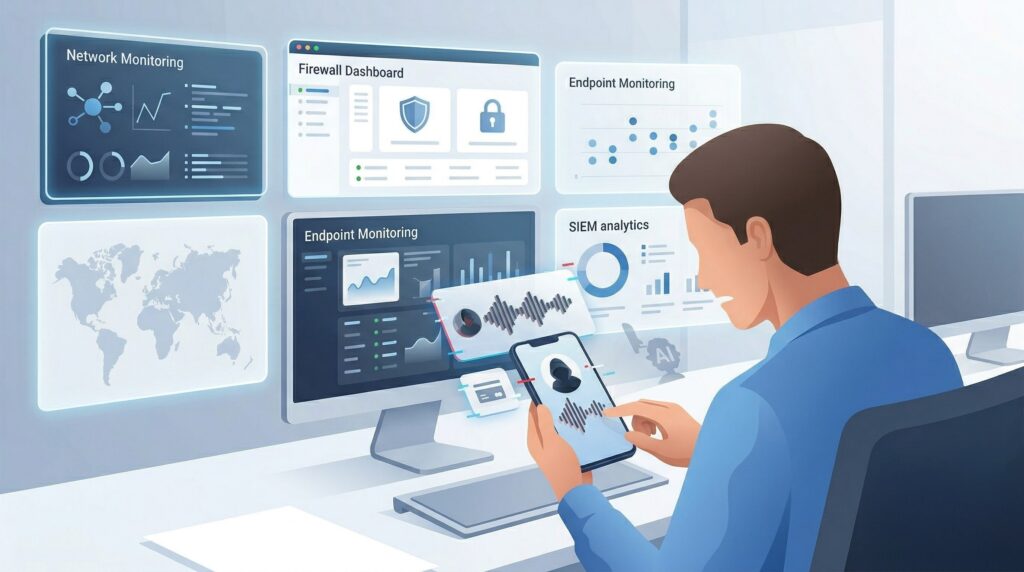
Why the Employee Security Gap in 2026 Goes Beyond Firewalls
The employee security gap in 2026 is not a firewall problem. In fact, it never was.
A mid-sized logistics company in Pune lost over 47 lakh rupees in four hours. Their firewall was enterprise-grade, while their endpoint detection remained best-in-class. Meanwhile, the SIEM team had fully tuned and optimized the system for threat monitoring. However, none of it mattered, because a finance executive received a voice note that sounded exactly like her CFO asking for an urgent vendor payment. She processed the transfer. The CFO had never sent that message.
This, therefore, is the nature of the employee security gap in 2026. Attackers have stopped trying to break through your defenses. Instead, attackers walk in through the front door using your CEO’s voice, your company’s branding, and a fake internal ticket. They do it in under three minutes using tools that cost almost nothing.
Accordingly, this post is for CISOs, IT managers, and founders who want to close that gap before it becomes their headline.
What the Employee Security Gap in 2026 Actually Means
The employee security gap in 2026 is the space between an organization’s technical security controls and the actual security behavior of its people.
It is not about ignorance. Most employees today know phishing exists. At the same time, it is also not about recklessness. Most people genuinely want to do the right thing. However, the gap still exists because attackers now understand human psychology better than most security training programs do. Furthermore, AI tools have lowered the cost of highly personalized social engineering to near zero.
Why Technical Controls Cannot Close This Gap Alone
Organizations designed workflows for efficiency, not for adversarial environments. As a result, human-layer security remains an afterthought compared to investment in technical controls.
Moreover, this gap remains hidden because vulnerability scanners do not detect it. It does not trigger your EDR. Instead, it lives in the space between your policy document and how your team actually behaves on a busy Tuesday afternoon when an urgent message arrives. Because this gap is invisible to most tools, it is therefore the most dangerous.
What Changed in 2026 and Why the Security Gap Is Wider
AI Has Made Social Engineering Industrial
Until recently, a convincing spear-phishing email required research, time, and skill. Today, however, an attacker feeds a target’s LinkedIn profile, email signature, and a few voice samples into a pipeline and produces a personalized attack in minutes.
AI-assisted phishing in 2026 is contextually aware. It references real internal projects, uses correct terminology, and adapts in real time. Consequently, traditional email security filters trained on syntactic anomalies struggle badly against this type of attack.
Deepfakes Have Become Operational
Meanwhile, deepfake voice synthesis now requires fewer than 30 seconds of audio. Video deepfakes are convincing enough for a quick video call. Therefore, the attack surface for deepfake fraud prevention failures is enormous. Payment authorization, identity verification, and executive impersonation are all viable attack vectors today.
To understand how organizations counter this, read 7 proven ways to beat deepfakes in 2026.
Shadow AI Is the New Shadow IT
Employees are adopting AI tools at a pace that far outstrips IT governance. Employees use ChatGPT, Gemini, and dozens of specialized tools to process customer data, draft contracts, and summarize internal documents, often without IT awareness or approval.
This is the shadow AI risk: sensitive data leaving the organization through channels that are invisible to your DLP, your CASB, and your security team. Consequently, this creates a significant employee security gap in 2026 that no firewall will detect. The guide to finding hidden shadow AI threats with pentesting covers this attack surface in detail.
Ransomware Now Targets Humans First
Modern ransomware gangs do not spray and pray. Instead, they target specific employees with access to high-value systems, socially engineer their way in, establish persistence, and then trigger ransomware at the most damaging moment. The entry point is almost always a human decision. Therefore, robust ransomware prevention for SMBs must start with hardening that human entry point. See the full breakdown at how to stop devastating ransomware threats in 2026.
The 7 Most Common Employee Security Gaps in 2026
Gap 1: Credential Reuse and Weak Password Hygiene
Despite years of training, credential reuse remains one of the most exploited human vulnerabilities. An employee who uses the same password for personal email and corporate VPN gives attackers a skeleton key the moment that personal account appears in a breach dump.
Gap 2: Shadow AI Data Leakage
Employees paste customer PII, financial projections, source code, and confidential contracts into public AI tools to work faster. Most do not consider this a security incident. Moreover, most organizations have no way to detect when it happens.
Gap 3: Over-Permission Tolerance
When employees receive broader access than they need and no one reviews those permissions, attackers who compromise the account inherit a far larger blast radius. This is a management and workflow failure, not merely a technical one.
Gap 4: Unverified Urgency Compliance
Humans are naturally wired to respond to urgency. Attackers exploit this by manufacturing time pressure. For example, attackers design messages like “process this by EOD or we lose the client” to make approval workflows feel optional. When those workflows can be bypassed under urgency, they effectively are optional.
Gap 5: Phishing Complacency After Training
One annual security awareness training session creates short-term improvement and a false sense of security. In contrast, organizations that run phishing simulations quarterly or monthly achieve significantly better results. Most organizations, however, still rely on yearly checkbox compliance training.
Gap 6: Insecure Personal Devices on Corporate Networks
BYOD policies that lack enforcement allow personal devices, often unpatched and running outdated software, to access corporate resources. Each of those devices is a potential entry point into your network.
Gap 7: Incident Non-Reporting Culture
Employees who click a suspicious link and say nothing out of embarrassment are one of the most dangerous gaps of all. Attackers still maintain an average dwell time in compromised networks that spans several weeks. Early reporting, therefore, collapses that window dramatically.
Common Mistake: Many organizations confuse security awareness with behavioral change. Showing employees a video about phishing is awareness. Running a simulated phishing campaign, reviewing who clicked, and coaching those individuals in context is behavioral change. Only one of those closes the employee security gap in 2026.
Early Warning Signals for the Employee Security Gap in 2026
Closing the employee security gap requires measurement. Without visibility, there is no way to know how wide the gap actually is.
Human Behavior Metrics to Track
| Metric | Target | Why It Matters |
|---|---|---|
| Phishing simulation click rate | Less than 5% | Measures susceptibility at scale |
| Phishing report rate | Above 40% | Measures vigilance and culture |
| Time-to-report after simulated click | Under 2 hours | Measures response reflexes |
| Security training completion rate | Above 95% | Baseline compliance signal |
| Repeat offenders in phishing simulations | Under 1% | Identifies individuals needing focused coaching |
Shadow AI and Access Metrics
| Metric | Target | Why It Matters |
|---|---|---|
| Unsanctioned AI tool usage (via CASB) | Trending down | Proxy for shadow AI risk |
| Accounts with unused elevated privileges | Zero | Reduces blast radius |
| Access review completion rate (quarterly) | 100% | Ensures permissions stay current |
| MFA adoption rate across critical systems | 100% | Closes the credential reuse gap |
Incident Response Metrics
| Metric | Target | Why It Matters |
|---|---|---|
| Mean time to report after employee-detected anomaly | Under 1 hour | Collapses attacker dwell time |
| Percentage of incidents originating from human action | Track trends | Quantifies human layer risk over time |
Use your AI vulnerability dashboard to correlate these human-layer signals with technical indicators for a unified risk view.
Controls That Close the Employee Security Gap in 2026
Policies That Organizations Actually Enforce
A policy that lives in a PDF no one reads is not a control. It is liability management. Effective policies in 2026 have three properties.
First, organizations embed policies into workflows instead of storing them in documents. Payment approval systems enforce policies by requiring a second click and a confirmation message. Policies that rely on employees remembering are not.
Second, they are proportional to risk. Apply strict controls to high-risk actions such as large payments, access provisioning, and executive communication. Not everything needs dual authorization.
Third, organizations update policies when threats change. The emergence of AI voice cloning, for instance, fundamentally changes how you should handle urgent payment requests from executives. If your policy predates deepfake audio, it is out of date.
Training That Changes Behavior
Annual compliance training is legal coverage, not security training. Behavioral security training looks different in practice.
Contextual micro-learning delivers 3 to 5 minute modules triggered by relevant events, such as a new phishing trend detected in your sector. Phishing simulations with immediate feedback coach employees the moment they click, not weeks later in a quarterly review. Role-specific content matters too. Finance teams should train on payment fraud. Executives should train on BEC and deepfakes. Developers should train on OWASP Top 10 vulnerabilities in 2026.
Finally, psychological safety for reporting is essential. Punitive cultures create unreported incidents and extended dwell times.
Pro Tip: Train your finance and operations teams specifically on payment fraud scenarios, not just generic phishing. The highest-value targets in social engineering are almost always people with payment authority, not IT staff.
Approval Workflows That Resist the Employee Security Gap
Design payment workflows that are adversarially resistant from the start.
Require a second approver for any payment above your defined threshold. For Indian SMBs, consider 5 lakh rupees as a starting point, then adjust based on your risk profile. Require out-of-band verbal confirmation for any payment instruction received via WhatsApp, SMS, or personal email from an executive.
Additionally, implement a mandatory cooling-off period, even 10 minutes, for payments flagged as urgent by the requester. Urgency is a social engineering signal, not a legitimate reason to bypass controls. Never allow users to add new payees and complete payments in the same transaction without a second approval.
Least Privilege and Access Reviews
Access creep is silent and nearly universal. Most employees in organizations older than two years have accumulated permissions they no longer need. These stale permissions represent significant risk.
To address this, conduct quarterly access reviews and automate the flagging of unused permissions. Implement just-in-time access for sensitive systems, where systems grant access for a defined task and revoke it automatically afterward. Also, remove admin rights from all accounts that do not actively require them, and keep admin accounts separate from daily-use accounts.
Shadow AI Discovery and Governance
You cannot govern what you cannot see. Shadow AI discovery, therefore, requires a structured approach.
Start with CASB or browser extension telemetry to identify AI tool usage across your organization. The results will likely surprise you. Next, create a sanctioned AI tool list. This is not a ban but rather a curated set of approved tools with agreed data handling terms. Pair this with data classification training so employees understand which categories of data should never enter a public AI tool.
Finally, use structured pentesting of shadow AI attack surfaces to identify which AI-enabled gaps are exploitable in your specific environment.
Incident Response Drills That Address the Security Gap
An IR plan that has never been exercised is not an IR plan. It is a first draft. Tabletop exercises and live drills build the muscle memory your team needs to respond well under pressure.
Run a tabletop exercise at minimum twice a year. Simulate a BEC payment fraud scenario and a ransomware encryption scenario separately. Measure your drill metrics: time to detection, time to containment, and time to communication. Crucially, include finance, HR, and legal in your IR drills, not just IT. The human-layer attacks of 2026 often require non-technical decision-makers to act first.
Traffic Potential and Engagement Boost Estimates
These are directional estimates only. Actual figures will vary based on domain authority, content quality, technical SEO implementation, and competitive dynamics at the time of publication.
Monthly Search Demand Estimates
| Keyword | Estimated Monthly Searches | Difficulty | Notes |
|---|---|---|---|
| employee security gap in 2026 | 500 to 2,000 | Low to Medium | Trending term with limited direct competition and commercial intent |
| shadow AI risk | 1,000 to 4,000 | Medium | Growing rapidly with mixed informational and commercial intent |
| AI-assisted phishing | 2,000 to 8,000 | Medium to High | High volume but competing with major security vendors |
| UPI phishing scams | 5,000 to 20,000 | Medium | Strong India-specific demand with lower competition for India-focused content |
| deepfake fraud prevention | 3,000 to 10,000 | Medium | Relatively new keyword cluster with first-mover advantage available |
Difficulty Reasoning: The primary keyword has low direct competition from authoritative domains. Secondary keywords compete with larger security vendors, but you can win through specificity and topical authority built with internal linking.
Expected Engagement Lifts
| Metric | Expected Range | Driver |
|---|---|---|
| Time on page | 6 to 10 minutes | Long-form depth, checklist, self-assessment |
| Scroll depth | 65 to 80% | Scannable H2/H3 structure and action checklists |
| Internal CTR to linked posts | 8 to 18% | 6 contextual internal links and Related Reading section |
| Return visit rate | Moderate uplift | Bookmarkable checklist and 90-day plan |
FAQs
Q. What is the employee security gap in 2026?
The employee security gap in 2026 refers to the difference between an organization’s technical security controls and the actual security behavior of its people. Specifically, it covers vulnerabilities created by shadow AI use, AI-assisted social engineering, deepfake fraud, and undertrained human responses to sophisticated attacks.
Q. How does shadow AI create a security risk for organizations?
Shadow AI occurs when employees use unauthorized AI tools to process work data. This exposes sensitive information such as customer PII, financial data, and source code to third-party AI systems without IT oversight. In many cases, it also violates data protection policies and regulatory obligations.
Q. Can a firewall protect against AI-assisted phishing?
No. Attackers design AI-assisted phishing attacks in 2026 to bypass technical email filters. They use properly configured lookalike domains that pass SPF and DKIM authentication, plus contextually personalized content that avoids pattern-based detection. The primary defense relies on trained employees and enforced workflow controls.
Q. What is the fastest way to reduce UPI phishing risk for a finance team?
Implement three controls right away. First, require out-of-band verbal confirmation for any payment instruction received digitally. Second, enforce dual authorization for all payments above a defined threshold. Third, run a payment fraud scenario in your next security awareness session using real UPI phishing examples.
Q. How do you detect deepfake voice or video fraud in practice?
Technical detection tools exist but are not reliable enough to depend on alone. Procedural controls are more effective. Establish a challenge question protocol for executive payment instructions, require all payment requests to come through official internal channels, and train employees to treat urgency as a red flag rather than a reason to bypass controls.
Q. Is shadow AI a compliance issue or just a security issue?
It is both. From a security perspective, shadow AI is an uncontrolled data exfiltration channel. From a compliance perspective, processing personal data through unauthorized AI tools may violate India’s Digital Personal Data Protection Act, GDPR for organizations with EU exposure, and sector-specific regulations like RBI guidelines for financial institutions.
Q. How often should organizations run phishing simulations to close the security gap?
At minimum, quarterly. Monthly simulations consistently produce better behavioral outcomes than annual ones. Research shows that simulation frequency, not just quality, is the primary driver of sustained improvement in employee click rates and report rates.
Q. What is least privilege and why does it matter for human-layer security?
Least privilege means every employee has access only to the systems and data they need for their current role. This matters because least privilege limits the attacker’s blast radius when phishing or credential theft compromises an employee account.Without it, a compromised junior account can become a pathway to your most sensitive systems.
Conclusion
The uncomfortable truth about the employee security gap in 2026 is that most organizations already have enough technical security to stop most attacks. Ultimately, organizations often lack behavioral security: trained, skeptical, process-following employees who recognize a deepfake voice note, know how to respond when an urgent payment request arrives on WhatsApp, and feel safe reporting a mistake.
Closing the employee security gap in 2026 does not require a new platform or a large budget. It requires treating human behavior as a security control that deserves the same rigor, measurement, and iteration as your firewall ruleset.
The 90-day plan in this post is a concrete starting point. The self-assessment will tell you where to begin. The 7 gaps in this article will tell you what to prioritize.
You already have the firewall. Now build the human layer.