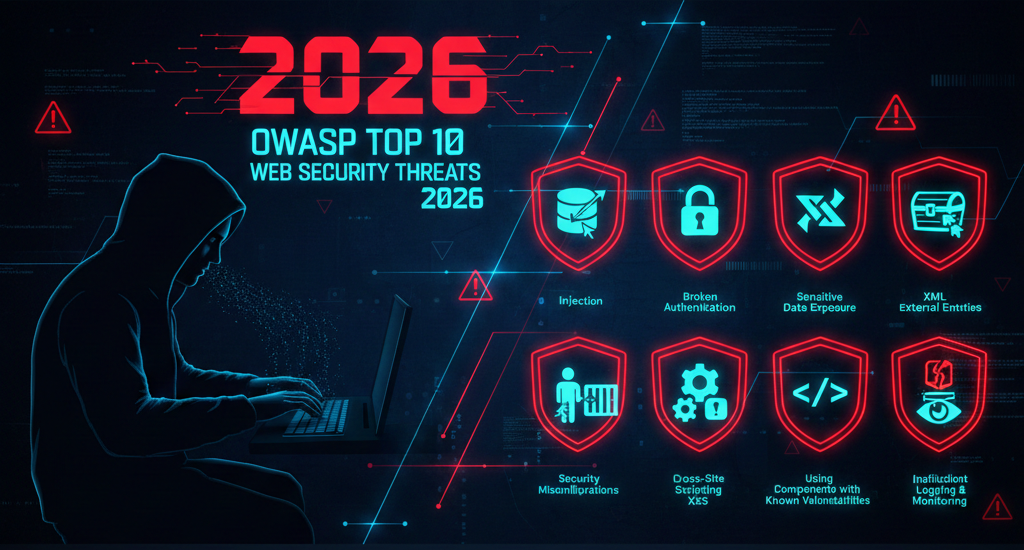
Every year, thousands of websites and applications get breached not through sci-fi zero-days, but through the same predictable, well-documented flaws. The OWASP Top 10 vulnerabilities represent the most critical web application security risks identified by the Open Web Application Security Project (OWASP), the world’s most trusted non-profit security authority. In 2026, these flaws are still responsible for the majority of real-world attacks, data breaches, and compliance failures.
Whether you are a developer trying to write secure code, a business protecting customer data, a cybersecurity student preparing for certifications, or a bug bounty hunter looking for your next valid finding understanding these OWASP flaws is non-negotiable. Moreover, hackers understand them better than most defenders do.
In this guide, we break down all 10 OWASP vulnerabilities in plain English. For each flaw, you will learn how it works, see a real-world breach example, understand exactly how hackers exploit it, and get actionable mitigation strategies to defend against it.
New to cybersecurity? Start by reading our beginner’s guide on how to start your cybersecurity journey as a student before diving into OWASP flaws.
A01 – Broken Access Control
What Is It?
Broken Access Control occurs when restrictions on what authenticated users are allowed to do are not properly enforced. Therefore, a regular user can act as an admin, view other users’ data, or access unauthorized pages by simply manipulating a URL or request parameter.
Real-World Example
In 2022, an attacker exploited Broken Access Control in a major fintech app by simply changing the account_id parameter in an API request from their own ID to another user’s. This gave them full read-write access to victims’ financial data no hacking tools required, just a browser and curiosity.
How Hackers Exploit It
- Modifying URL parameters:
/admin/users?id=1337→/admin/users?id=1 - Forcing direct object references (IDOR) to access other users’ records
- Accessing admin endpoints without being an admin (e.g.,
/admin/panel) - Exploiting missing server-side authorization checks
Prevention & Mitigation
- Enforce access control on the server side never trust client-side restrictions
- Implement role-based access control (RBAC) with the principle of least privilege
- Deny all access by default; explicitly allow only what is needed
- Log and alert on access control failures regularly
- Conduct regular VAPT audits to catch authorization gaps early
A02 – Cryptographic Failures
What Is It?
Formerly called “Sensitive Data Exposure,” this OWASP flaw occurs when applications fail to adequately protect sensitive data in transit or at rest. In essence, data that should be encrypted is either not encrypted at all, or uses weak, outdated cryptographic algorithms.
Real-World Example
The 2013 Adobe breach exposed 153 million user records, including passwords hashed with the notoriously weak MD5 algorithm. Hackers cracked millions of passwords in hours using rainbow tables, which then led to massive credential-stuffing campaigns across the internet.
How Hackers Exploit It
- Man-in-the-middle (MitM) attacks on unencrypted HTTP connections
- Cracking weakly hashed passwords (MD5, SHA-1) with rainbow tables
- Stealing session tokens transmitted without TLS
- Accessing sensitive data stored in plaintext in databases or config files
Prevention & Mitigation
- Use TLS 1.3 for all data in transit; enforce HTTPS sitewide
- Hash passwords with bcrypt, Argon2, or PBKDF2 never MD5 or SHA-1
- Encrypt sensitive data at rest using AES-256
- Disable caching for responses containing sensitive data
- Refer to NIST cryptographic guidelines for current standards
A03 – Injection
What Is It?
Injection flaws occur when untrusted data is sent to an interpreter as part of a command or query. SQL Injection (SQLi) is the most notorious example, but injection also covers OS command injection, LDAP injection, and cross-site scripting (XSS). However, all share the same root cause: insufficient input validation.
Real-World Example
In 2008, Heartland Payment Systems suffered one of the largest payment card breaches in history via SQL Injection, exposing over 130 million credit card numbers. The attackers used a simple SQLi payload to extract the entire database no advanced tools needed.
Classic SQL Injection Example
-- Vulnerable query (never do this)
SELECT * FROM users WHERE username = '' OR '1'='1';

-- Result: returns ALL users login completely bypassed!
How Hackers Exploit It
- Entering
' OR '1'='1in login fields to bypass authentication - Using
UNION SELECTstatements to extract data from other tables - Injecting OS commands through vulnerable input fields
- Automating attacks with tools like SQLmap
Prevention & Mitigation
- Use parameterized queries / prepared statements always, no exceptions
- Apply server-side input validation and allowlisting
- Use an ORM (like SQLAlchemy or Hibernate) that handles escaping automatically
- Deploy a Web Application Firewall (WAF) to detect injection payloads
- Reference the MITRE CWE-89 definition for full technical depth
A04 – Insecure Design
What Is It?
Insecure Design is a relatively new OWASP category that highlights missing or ineffective security controls baked into the architecture of an application. It is fundamentally different from implementation bugs the security problem exists because it was never thought about during design. Therefore, no amount of code-level patching can fix a broken design; the architecture itself must be reconsidered.
Real-World Example
A popular retail app allowed customers to reset their password using only their date of birth no email verification, no secondary factor. Attackers guessed birthdates from social media profiles and took over thousands of accounts. The flaw was a design decision, not a coding error.
How Hackers Exploit It
- Abusing poorly designed password reset flows
- Exploiting business logic flaws baked into workflows
- Using “what the app is supposed to do” against itself
- Bypassing rate limits that were never designed into the system
Prevention & Mitigation
- Follow Secure-by-Design and Secure-by-Default principles from day one
- Conduct threat modeling (e.g., STRIDE framework) during the design phase
- Use security design patterns and reference architectures
- Integrate security requirements into user stories and acceptance criteria
- Review the OWASP Developer Guide for secure design practices
A05 – Security Misconfiguration
What Is It?
Security Misconfiguration is the most commonly found OWASP flaw in the wild. It occurs when default configurations are left unchanged, unnecessary features are enabled, verbose error messages are exposed publicly, or cloud storage buckets are left open. Moreover, misconfigurations are often trivially exploitable by anyone no advanced skills needed.
Real-World Example
In 2019, Capital One suffered a breach affecting 100 million customers. The attacker exploited a misconfigured AWS WAF that allowed Server-Side Request Forgery (SSRF) to reach the EC2 metadata endpoint and steal IAM credentials all because of one cloud misconfiguration.
Common Misconfigurations
- Default admin credentials left unchanged (admin/admin)
- Unnecessary ports and services exposed to the internet
- Detailed stack traces shown in production error messages
- S3 buckets or cloud storage set to public access
- Missing security HTTP headers (no
Content-Security-Policy, noHSTS)
Prevention & Mitigation
- Implement a hardened, repeatable configuration process for all environments
- Remove unused features, frameworks, components, and privileges
- Send security headers:
X-Frame-Options,Content-Security-Policy,HSTS - Run automated scanning tools regularly (e.g., Nessus, OpenSCAP)
- Use Infrastructure-as-Code (IaC) with security policies enforced at deployment
A06 – Vulnerable & Outdated Components
What Is It?
Modern applications depend on dozens sometimes hundreds of third-party libraries, frameworks, and packages. When these components have known vulnerabilities and go unpatched, the entire application is at risk. Notably, attackers actively scan for applications running known vulnerable versions and exploit them at scale.
Real-World Example
The 2017 Equifax breach one of history’s worst data breaches exposed the personal data of 147 million people. The root cause was an unpatched Apache Struts vulnerability (CVE-2017-5638) that had a patch available for months. The company simply failed to update the component in time.
How Hackers Exploit It
- Scanning for applications using vulnerable library versions
- Downloading public exploit code (PoC) for known CVEs
- Targeting unpatched CMS plugins (WordPress, Drupal, etc.)
- Exploiting abandoned or unmaintained open-source packages
Prevention & Mitigation
- Maintain a Software Bill of Materials (SBOM) for all dependencies
- Use tools like Dependabot, Snyk, or OWASP Dependency-Check to scan for known CVEs
- Remove unused dependencies and libraries from your project
- Subscribe to security advisories for components you actively use
- Monitor the NIST National Vulnerability Database (NVD) for new CVEs
A07 – Identification & Authentication Failures
What Is It?
This OWASP vulnerability covers weaknesses in authentication and session management. When attackers can compromise passwords, session tokens, or exploit broken authentication flows, they can assume other users’ identities including administrators. Furthermore, credential stuffing attacks using breached password databases are now fully automated and extremely widespread.
Real-World Example
In 2020, a credential-stuffing attack against a major streaming platform compromised hundreds of thousands of accounts. The application had no rate limiting, no MFA, and no anomaly detection attackers simply tried millions of username/password combinations until they found matches.
How Hackers Exploit It
- Credential stuffing using breached username/password lists
- Brute-forcing weak passwords with no rate limiting
- Session hijacking by stealing poorly secured tokens
- Exploiting insecure “remember me” and password reset flows
Prevention & Mitigation
- Implement Multi-Factor Authentication (MFA) it blocks 99.9% of automated attacks
- Enforce rate limiting and account lockout on all login endpoints
- Use secure session management: regenerate tokens after login, set proper expiry
- Check passwords against breached databases (e.g., Have I Been Pwned API)
- Never allow weak passwords enforce minimum 12 characters with complexity
Important for businesses: Learn how AI-driven phishing bypasses traditional authentication in our guide on AI-driven cyber threats in 2026.
A08 – Software & Data Integrity Failures
What Is It?
This category covers assumptions made about software updates, critical data, and CI/CD pipelines without verifying integrity. In other words, if your application automatically downloads and executes code without checking its authenticity, attackers can substitute malicious code a classic supply chain attack.
Real-World Example
The SolarWinds Orion attack (2020) is the most famous supply chain attack in history. Attackers compromised the build pipeline of a trusted software vendor and inserted malicious code into a signed, legitimate software update. Consequently, 18,000+ organizations including US government agencies unknowingly installed the backdoor.
How Hackers Exploit It
- Compromising CI/CD pipelines to inject malicious code
- Tampering with software update mechanisms
- Publishing malicious packages with names similar to popular ones (typosquatting)
- Stealing code-signing certificates to make malicious code appear legitimate
Prevention & Mitigation
- Verify digital signatures on all software packages and updates
- Use a trusted, signed pipeline for CI/CD; implement code-signing at every stage
- Integrate SBOM generation into your build process
- Implement Subresource Integrity (SRI) checks for third-party scripts in HTML
- Review the Google Security Blog for the latest supply chain threat intelligence
A09 – Security Logging & Monitoring Failures
What Is It?
Without adequate logging and monitoring, breaches go undetected for extended periods. In fact, the average time to detect a breach globally is still over 200 days. Therefore, attackers have months to silently exfiltrate data, escalate privileges, and pivot through systems entirely unnoticed by the security team.
Real-World Example
The Marriott International breach (2018) remained undetected for four years from 2014 to 2018. During this time, attackers accessed the records of 500 million guests. Inadequate security monitoring allowed the breach to persist until an internal security tool finally flagged suspicious activity years later.
How Hackers Exploit It
- Operating slowly and quietly to avoid triggering alerts
- Deleting or tampering with log files after a breach
- Exploiting systems that generate logs but never actually monitor them
- Using legitimate credentials (often stolen) to blend into normal traffic
Prevention & Mitigation
- Log all authentication events, access control failures, and input validation errors
- Implement a SIEM (Security Information and Event Management) solution
- Set up real-time alerts for suspicious behavior patterns
- Ensure logs are stored on a separate, tamper-proof system
- Conduct regular incident response drills to test detection capabilities
A10 – Server-Side Request Forgery (SSRF)
What Is It?
SSRF occurs when an attacker can make the server send requests to unintended locations including internal services and cloud metadata APIs that should never be publicly accessible. This OWASP flaw surged in significance with the rise of cloud infrastructure, where internal metadata endpoints can expose credentials and configuration secrets.
Real-World Example
The Capital One breach (2019) was driven by SSRF. The attacker forced the server to call the AWS EC2 Instance Metadata Service at http://169.254.169.254/, which returned IAM credentials. Those credentials were then used to access S3 buckets containing 100 million customer records.
How Hackers Exploit It
-- Attacker submits a URL to a "fetch image" feature:
POST /api/fetch-image
{ "url": "http://169.254.169.254/latest/meta-data/iam/security-credentials/" }

-- Server fetches it internally and returns cloud IAM credentials!
Prevention & Mitigation
- Validate and sanitize all user-supplied URLs; use strict allowlists
- Block requests to private/internal IP ranges (127.x, 169.254.x, 10.x, 192.168.x)
- In AWS, disable IMDSv1 and enforce IMDSv2 with session tokens
- Segment internal services and use network-level egress controls
- Consider dedicated URL-fetching microservices with strict outbound controls
OWASP Top 10 Quick Reference Table
The following table provides a concise overview of all 10 OWASP vulnerabilities, their risk level, and the primary defense strategy for each.
| # | OWASP Flaw | Risk Level | Primary Defense | Exploitability |
|---|---|---|---|---|
| A01 | Broken Access Control | 🔴 Critical | Server-side RBAC + deny-by-default | Easy |
| A02 | Cryptographic Failures | 🔴 Critical | TLS 1.3 + bcrypt/Argon2 | Moderate |
| A03 | Injection | 🔴 Critical | Parameterized queries + input validation | Easy |
| A04 | Insecure Design | 🟠 High | Threat modeling + secure design patterns | Moderate |
| A05 | Security Misconfiguration | 🟠 High | Hardened configs + regular audits | Easy |
| A06 | Vulnerable Components | 🟠 High | SBOM + automated dependency scanning | Easy |
| A07 | Auth Failures | 🟠 High | MFA + rate limiting + secure sessions | Easy |
| A08 | Integrity Failures | 🟠 High | Code signing + trusted CI/CD pipeline | Hard |
| A09 | Logging & Monitoring | 🟡 Medium | SIEM + real-time alerting | Varies |
| A10 | SSRF | 🔴 Critical | URL allowlisting + network segmentation | Moderate |
Master Prevention Checklist for Developers & Businesses
Use this checklist to audit your application against the most critical OWASP vulnerabilities before deploying to production.
- All access control decisions are enforced server-side never client-side
- Sensitive data is encrypted at rest (AES-256) and in transit (TLS 1.3)
- Passwords are hashed using bcrypt, Argon2, or PBKDF2 not MD5/SHA-1
- All database queries use parameterized statements or an ORM
- Threat modeling has been performed for all new features
- Default credentials and configurations have been changed on all systems
- All dependencies are tracked and scanned for known CVEs (SBOM in place)
- Multi-Factor Authentication is available for all user accounts
- Rate limiting and account lockout are implemented on authentication endpoints
- Software updates and CI/CD artifacts are verified with code signing
- All authentication events and access control failures are logged
- A SIEM or log management system is in place with real-time alerting
- All user-supplied URLs are validated against an allowlist before server-side requests
- Cloud metadata endpoints are protected (IMDSv2 enforced, network segmented)
- A regular VAPT audit schedule is in place
Bug Bounty Hunters: These 10 OWASP flaws are the foundation of every successful bug bounty submission. Our bug bounty guide for beginners and the business guide to ethical hacking will help you turn OWASP knowledge into real rewards.
Frequently Asked Questions (FAQ)
Q: What are the OWASP Top 10 vulnerabilities?
Q: Is the OWASP Top 10 still relevant in 2026?
Q: How do hackers exploit Broken Access Control?
Q: What is the difference between authentication and authorization vulnerabilities?
Q: Can beginners learn web application security from OWASP?
Q: How do I protect my business from OWASP vulnerabilities?
Conclusion
The OWASP Top 10 vulnerabilities are not just a list they are a mirror reflecting the most persistent, exploitable weaknesses that attackers use to compromise real applications every single day. In 2026, despite decades of awareness, Broken Access Control still tops the list, SQL Injection still works, and outdated components still bring down enterprises.
However, the good news is clear: every one of these OWASP flaws is preventable. With the right knowledge, secure coding practices, regular audits, and proper tooling, you can eliminate the vast majority of web application security risks before attackers ever get the chance to exploit them.
Whether you are securing your application, preparing for a bug bounty hunt, studying for a security certification, or simply trying to protect your users’ data mastering these 10 OWASP vulnerabilities is the single best investment you can make in your cybersecurity knowledge.
For a broader view of where web security threats are heading, check out our analysis of cybersecurity trends and top threats and learn how to protect your personal data from hackers.