

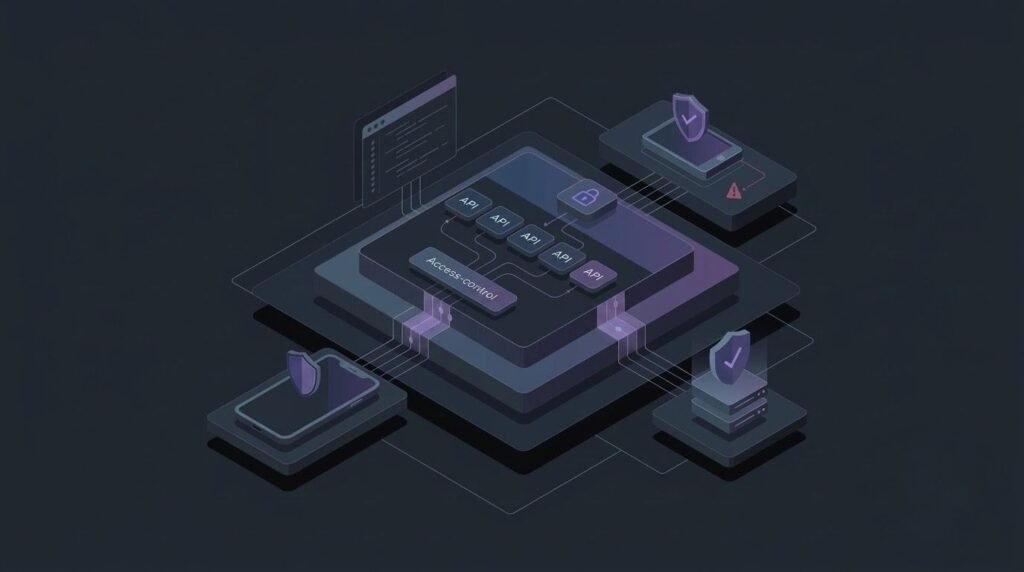
Mobile apps rarely work alone. Almost every screen you tap talks to a backend server through an API, fetching data, processing payments, or verifying who you are. These connections make mobile apps powerful, but they also make Mobile API Security one of the most important parts of building a safe application.
An API (Application Programming Interface) is the bridge between your mobile app and its backend services. Because mobile apps depend so heavily on APIs, any weakness in that bridge can expose user data, authentication tokens, business logic, or entire backend systems. Attackers often find it easier to target the API than the app itself, since the API controls what data flows in and out.
This article walks through ten of the most common mobile API vulnerabilities. For each one, you will learn what it means, how it affects mobile applications specifically, a simple conceptual example, the potential impact, and practical steps developers can take to prevent it. Whether you are a developer, a security professional, or a student learning application security, this guide will give you a clear, practical foundation in Mobile API Security.
Mobile API Security at a Glance
| Vulnerability | Common Risk | Recommended Defense |
|---|---|---|
| Broken Object Level Authorization (BOLA) | Users access other users’ data | Server-side ownership checks on every request |
| Broken Authentication | Account takeover via weak tokens or sessions | Strong token lifecycle and secure session handling |
| Excessive Data Exposure | API returns more data than the app needs | Response filtering and data minimization |
| Improper Authorization | Users perform actions above their role | Role-based access control enforced server-side |
| Lack of Rate Limiting | Brute force and credential stuffing | Throttling, lockouts, and abuse detection |
| Insecure Direct Object References | Predictable IDs expose other records | Unpredictable identifiers plus access checks |
| Injection Vulnerabilities | Malicious input manipulates queries or commands | Parameterized queries and input validation |
| Security Misconfiguration | Debug endpoints, weak CORS, verbose errors | Hardened default configurations and audits |
| Insecure API Key and Token Storage | Hardcoded secrets extracted from the app | Backend-issued, short-lived, rotated credentials |
| Insufficient Monitoring and Logging | Attacks go undetected for long periods | Centralized logging, alerting, and response plans |
1. Broken Object Level Authorization (BOLA)
What It Means
Broken Object Level Authorization happens when an API lets a user access an object, such as an order or profile, that belongs to someone else. The API checks that a user is logged in, but it fails to check whether that user actually owns the specific record being requested.
How It Affects Mobile APIs
Mobile apps frequently pass object identifiers, like order IDs or user IDs, in API requests. If the backend does not verify ownership on every request, an attacker can simply change these identifiers to pull records that do not belong to them.
Example
Imagine a fitness app where a request retrieves workout history using a numeric user ID in the URL. If the server only checks that the requester is logged in, and not whether the ID matches that user’s own account, someone could potentially view another person’s workout data by changing the number.
Security Impact
Left unresolved, BOLA can expose personal records, financial details, or private messages across an entire user base. Because the flaw is systemic, one weak endpoint can affect every account on the platform.
How Developers Can Prevent It
- Verify object ownership on the server for every request, not just authentication status
- Avoid relying on the client to enforce access rules
- Use indirect references or access-control middleware for sensitive objects
- Test every endpoint that accepts an object ID as a parameter
This pattern is closely related to broader access control failures, which the OWASP Top 10 vulnerabilities guide covers in more detail for web applications.
2. Broken Authentication
What It Means
Broken authentication covers weaknesses in how an API verifies user identity. This includes weak password rules, poor token handling, and session management that does not expire or invalidate properly.
How It Affects Mobile APIs
Mobile apps often store access tokens and refresh tokens locally so users do not need to log in repeatedly. However, if these tokens are long-lived, predictable, or poorly validated, attackers can hijack sessions without ever knowing a password.
Example
Consider an app that issues access tokens that never expire and accepts the same token indefinitely, even after a user changes their password. A leaked token would remain valid forever, giving an attacker permanent access.
Security Impact
Broken authentication can lead directly to account takeover. Once an attacker holds a valid token, they can impersonate the user and access everything that account is authorized to see or do.
How Developers Can Prevent It
- Issue short-lived access tokens paired with securely stored refresh tokens
- Invalidate tokens after password changes, logout, or suspicious activity
- Enforce strong authentication standards, including multi-factor options where appropriate
- Avoid transmitting credentials or tokens in URLs
Weak credential handling is also a leading cause of cloud account compromise, as explained in this overview of cloud security threats and credential theft.
3. Excessive Data Exposure
What It Means
Excessive data exposure occurs when an API returns more information than the mobile app actually needs, relying on the client to filter out sensitive fields before displaying them.
How It Affects Mobile APIs
Mobile developers sometimes reuse a single backend endpoint across multiple screens for convenience. As a result, the API may return full user records, including fields like internal IDs, hashed passwords, or admin flags, even when the app only displays a name and photo.
Example
A user profile endpoint might return an entire database record, including internal notes or account status flags, while the app interface only shows a username and avatar.
Security Impact
Attackers can intercept API traffic and read fields that were never meant to reach the client. Even unused data sitting in a response is a liability, since it can be captured, stored, and analyzed later.
How Developers Can Prevent It
- Design API responses around what the client needs, not what the database contains
- Filter sensitive fields on the server before sending a response
- Apply data minimization as a default design principle
- Review API responses regularly for unnecessary or sensitive fields
4. Improper Authorization
What It Means
Authentication confirms who a user is. Authorization determines what that user is allowed to do. Improper authorization happens when an API correctly identifies a user but fails to restrict their actions based on role or permission level.
How It Affects Mobile APIs
Mobile apps often have multiple user roles, such as regular users, moderators, and administrators. If the API does not enforce these roles server-side, a standard user could potentially call an admin-only function directly.
Example
An app might hide an admin panel in the user interface, but if the underlying API endpoint for deleting accounts accepts requests from any authenticated user, that endpoint remains exploitable regardless of what the app’s screens show.
Security Impact
Improper authorization can lead to privilege escalation, where a regular user gains admin-level control. This can result in unauthorized data changes, service disruption, or full account compromise.
How Developers Can Prevent It
- Implement role-based access control (RBAC) enforced entirely on the server
- Never rely on hidden UI elements as a security control
- Re-verify permissions on every sensitive action, not just at login
- Log and monitor privileged actions for unusual patterns
5. Lack of Rate Limiting
What It Means
Rate limiting controls how many requests a client can send to an API within a given time period. Without it, an API has no defense against high-volume automated abuse.
How It Affects Mobile APIs
Mobile login and password-reset endpoints are common targets for brute-force attacks and credential stuffing, where attackers test large lists of leaked username-password pairs. Because mobile APIs are often publicly reachable, they are easy to automate against.
Example
An attacker could script thousands of login attempts per minute against a mobile app’s authentication endpoint, testing stolen credentials from other data breaches until one combination succeeds.
Security Impact
Without rate limiting, attackers can compromise accounts through brute force, overwhelm backend servers, or scrape large volumes of data quickly. This also increases infrastructure costs and can degrade service for legitimate users.
How Developers Can Prevent It
- Apply rate limiting and throttling on authentication and sensitive endpoints
- Use account lockouts or progressive delays after repeated failures
- Deploy CAPTCHA or device-based checks for suspicious request patterns
- Monitor for spikes in traffic from a single source
Real-world abuse scenarios like this are discussed further in this collection of OWASP Top 10 vulnerabilities with real examples.
6. Insecure Direct Object References (IDOR)
What It Means
Insecure Direct Object References happen when an API exposes internal identifiers, such as sequential database IDs, without properly restricting which records a user can request.
How It Affects Mobile APIs
Mobile apps frequently pass identifiers like invoice numbers or file IDs in API calls. If these identifiers are predictable and access is not properly restricted, a user could guess or enumerate other valid IDs.
Example
Consider an API endpoint that retrieves an invoice using a simple numeric ID in the request. If the numbers increase sequentially and the server does not confirm ownership, changing the number could theoretically reveal another customer’s invoice, assuming access controls are missing.
Security Impact
IDOR issues can expose large volumes of user data with minimal effort from an attacker, since sequential IDs are trivial to enumerate. This often results in widespread data exposure rather than a single isolated record leak.
How Developers Can Prevent It
- Use unpredictable identifiers, such as UUIDs, instead of sequential numbers
- Enforce authorization checks on every object request, independent of the identifier type
- Avoid exposing internal database IDs directly in API responses where possible
- Test access controls specifically for object enumeration scenarios
7. Injection Vulnerabilities
What It Means
Injection vulnerabilities occur when untrusted input is passed to an interpreter, such as a SQL database or system shell, without proper validation. This allows attackers to manipulate queries or commands.
How It Affects Mobile APIs
Mobile apps send user input, such as search terms or form data, to backend APIs constantly. If that input is inserted directly into database queries or system commands, it opens the door to SQL injection, NoSQL injection, or command injection.
Example
A search feature that builds a database query by directly concatenating user input, instead of using parameterized queries, could allow crafted input to change the query’s meaning and return unintended data.
Security Impact
Successful injection attacks can expose entire databases, allow data modification, or in severe cases, grant attackers control over backend systems. The consequences scale with how much access the affected backend component has.
How Developers Can Prevent It
- Use parameterized queries or prepared statements for all database interactions
- Validate and sanitize all user input on the server, not just the client
- Apply the principle of least privilege to database accounts used by the API
- Follow established guidance such as the OWASP SQL Injection Prevention Cheat Sheet when building query logic
8. Security Misconfiguration
What It Means
Security misconfiguration covers a wide range of issues, including exposed debug endpoints, excessive permissions, improper CORS settings, verbose error messages, and default or insecure settings left unchanged.
How It Affects Mobile APIs
Mobile backends often include debug tools, staging environments, or verbose logging that were never meant to reach production. If these are accidentally exposed, they can reveal system internals or provide attackers with unintended access points.
Example
An API that returns a full stack trace on error, including server file paths and framework versions, gives attackers useful information for planning further attacks, even without any successful exploit yet.
Security Impact
Misconfigurations rarely cause harm on their own, but they frequently act as a stepping stone. Attackers combine exposed information with other weaknesses to escalate a minor issue into a serious breach.
How Developers Can Prevent It
- Disable debug endpoints and verbose error messages in production environments
- Configure CORS policies restrictively, allowing only trusted origins
- Remove default credentials and unnecessary features before deployment
- Run periodic configuration audits across all environments
Misconfigured components, including third-party dependencies, are also a common entry point in software supply chain attacks, so configuration reviews should extend beyond your own code.
9. Insecure API Key and Token Storage
What It Means
This vulnerability involves storing API keys, secrets, or tokens in ways that make them easy for attackers to extract, such as hardcoding them directly inside the mobile application’s code.
How It Affects Mobile APIs
Mobile apps ship as binaries that users download to their devices. Anyone can decompile or inspect that binary, meaning any secret embedded in the app is not truly secret. This is a critical distinction: client-side storage should never be treated as confidential.
Example
A developer hardcodes a backend API key directly into the app’s source code so the app can authenticate with a service. Once the app is published, that key can potentially be extracted through reverse engineering, regardless of how well the code is obfuscated.
Security Impact
Exposed keys can allow attackers to impersonate the app, abuse backend resources, run up costs, or access data the key was never meant to expose publicly. Because mobile apps are widely distributed, one leaked key can affect every installed copy.
How Developers Can Prevent It
- Avoid embedding long-lived secrets directly in mobile app code
- Issue short-lived, user-specific tokens from the backend after authentication
- Use secure backend architecture where sensitive operations happen server-side, not on the device
- Rotate credentials regularly and monitor for unusual key usage
Proper secrets handling on the backend is just as important as mobile-side protections; this guide on secrets management and credential exposure covers backend practices in more depth.
10. Insufficient API Monitoring and Logging
What It Means
Insufficient monitoring and logging means an organization lacks the visibility needed to detect and respond to suspicious API activity in a timely manner.
How It Affects Mobile APIs
Mobile APIs handle constant, high-volume traffic from many devices, which makes it easy for malicious activity to blend in with normal usage. Without proper logging, unusual patterns such as repeated authentication failures or abnormal data access can go unnoticed for weeks or longer.
Example
An attacker slowly enumerates user records over several days, staying under typical rate-limiting thresholds. Without logging and alerting in place, this activity may never be flagged as suspicious.
Security Impact
Poor monitoring extends the time attackers have to operate undetected, often called dwell time. Longer dwell time typically means more data exposed and a more complex, costly incident response process.
How Developers Can Prevent It
- Log authentication failures, authorization failures, and unusual request patterns
- Centralize logs in a system that supports searching, correlation, and alerting
- Set up automated alerts for suspicious activity, such as spikes in failed logins
- Maintain and test an incident response plan specifically for API-related incidents
Conclusion
Mobile API Security should be treated as an ongoing part of the development lifecycle, not a one-time checklist. Every one of the vulnerabilities covered here, from BOLA to insufficient logging, stems from gaps between what an API assumes and what it actually verifies.
Building a strong security posture means combining several practices together: strong authentication, server-side authorization, careful input validation, secure token handling, and sensible rate limiting. It also means maintaining secure configurations, monitoring activity continuously, and testing your systems on a regular schedule.
No single control solves every problem. However, layering these defenses consistently gives mobile applications a much stronger foundation. Teams that treat Mobile API Security as a continuous discipline, rather than a launch-day task, are far better positioned to protect their users and their business over time.
Frequently Asked Questions
What is Mobile API Security?
Mobile API Security refers to the practices and controls used to protect the APIs that mobile applications rely on to communicate with backend servers. It covers authentication, authorization, data protection, and monitoring to prevent unauthorized access or data exposure.
Why is API security important for mobile applications?
Mobile apps depend on APIs for nearly every function, including login, payments, and data retrieval. If an API is insecure, attackers can bypass the app entirely and interact with the backend directly, exposing user data or business logic.
What are the most common mobile API vulnerabilities?
Common issues include broken object level authorization, broken authentication, excessive data exposure, lack of rate limiting, injection flaws, and insecure storage of API keys or tokens, among others covered by the OWASP API Security Top 10.
How can developers secure mobile APIs?
Developers should enforce authorization checks server-side, use short-lived tokens, validate all input, apply rate limiting, configure systems securely, and monitor API traffic continuously for suspicious activity.
What is BOLA in API security?
BOLA, or Broken Object Level Authorization, occurs when an API fails to verify that a user actually owns the specific object they are requesting, allowing access to other users’ data through simple ID manipulation.
How should mobile API tokens be protected?
Tokens should be short-lived, issued by the backend after proper authentication, and stored securely on the device. Long-lived secrets should never be hardcoded into the app, since mobile binaries can be reverse engineered.
How often should mobile APIs be security tested?
Mobile APIs should be tested regularly, ideally with every major release, alongside periodic independent security assessments. Continuous monitoring should supplement, not replace, scheduled testing.